Get to ETL sooner
Reduce preparation and mapping effort while carrying approved decisions into the next migration wave.
60–80% faster to first runnable ETL
MOVE.AI
MOVE turns legacy data structures into reviewed, approved migration specifications and then generates ETL, reconciliation assets from the same specification. Your SMEs stay in control, decisions remain traceable and validation is planned from day one.
Legacy data rarely arrives neatly documented. Teams must interpret fields, map complex relationships and prove that the migrated data reconciles—often under cutover pressure.
Thousands of columns are mapped in spreadsheets, slowing preparation and review.
What a field means can leave with the people who knew the legacy system.
Reconciliation is often designed just before cutover, when time is shortest.
Every migration starts from a blank sheet instead of learning from prior waves.
INTRODUCING MOVE.AI
A governed migration workflow that reduces manual effort, makes decisions traceable and brings reconciliation into the plan from day one.
Profile source and target layouts.
Review mappings with your SMEs.
Create ETL and reconciliation assets.
Reduce preparation and mapping effort while carrying approved decisions into the next migration wave.
Map source and target structures at table, join and column level—not just selected samples.
Review confidence, retain decision reasons and trace each AI answer to its source.
Generate recon plans and scripts from the same approved specification as your ETL.
AI recommends. SMEs decide. The approved specification generates ETL and reconciliation assets.
Turn source layouts into documented, profiled and versioned packages.
Outputs: profiled tables, column dictionary, sanctity report and versioned package.
Map source and target structures with transparent recommendations.
Outputs: table and column mappings, confidence per row and approved specification.
Convert approved specifications into assets teams can run in their environment.
Outputs: SQL ETL, pandas ETL, reconciliation plan and scripts.
A structured approach to source understanding, mapping, validation and execution hand-off.
Work with database layouts, COBOL copybooks, JSON schemas, flat files and knowledge catalogues to build profiled source packages.
Identify primary and contributing sources, join keys and table relationships with AI-assisted recommendations.
Recommend source fields and transformations for target columns, with confidence and decision rationale.
Keep review decisions visible and prevent approval while mapping rows remain unresolved.
Generate SQL or Python/pandas ETL alongside a reconciliation plan based on approved specifications.
Capture description corrections, mapping decisions, transformation choices and reconciliation outcomes in a migration knowledge ledger.
The learning ledger is intended to help teams carry approved migration knowledge forward between waves within the same programme. Reuse is conditional: information must be eligible, relevant to the next wave and reviewed under the programme’s agreed data-handling rules.
Approved descriptions and mapping decisions, where these are supported by the deployed implementation and permitted by programme rules.
Check the source, target and business context before carrying a decision into the next wave; previous approval does not automatically approve a new mapping.
Reuse is described here only within the same programme. No cross-client knowledge sharing is promised or implied.
Where supported by the implementation, retain the origin and approval status so reviewers can assess why a decision is being reused.
THE DIFFERENCE WITH MOVE
Replace disconnected manual tasks with a repeatable process where mappings, decisions and reconciliation stay connected.
Manual effort grows with every table and column.
Rationale gets scattered across emails and people.
Teams spend time writing rather than reviewing.
Validation pressure builds near cutover.
AI proposes; SMEs review and decide.
Every decision is recorded with its reason.
Generate assets from the approved specification.
Plan and scripts are generated with the spec.
Migration data, credentials, AI-provider handling and knowledge retention should be governed by the controls confirmed for each deployment. MOVE’s security and data-handling details must match the actual configured implementation—not assumptions.
Define which source data and metadata MOVE processes, where processing occurs and which assets are generated or executed in the customer environment.
Confirm access permissions and credential storage or persistence behaviour against the deployed configuration.
Set out what migration knowledge and project data are retained, for how long, and how deletion is handled under the applicable programme rules.
Confirm what information is sent to any AI provider and what decision history or provenance is recorded and available to authorised reviewers.
MOVE is designed to help teams make migration work more repeatable, reviewable and measurable. Actual outcomes should be baselined for each engagement.
Use AI-assisted recommendations instead of relying entirely on manual mapping.
Capture SME decisions, reasons and provenance as part of the workflow.
Generate runnable ETL and reconciliation assets from approved specifications.
Carry trusted mapping knowledge forward instead of starting with a blank sheet.
MOVE analyses source data, recommends mappings for expert review, then generates ETL workflows and migration-ready assets from the same approved specification.
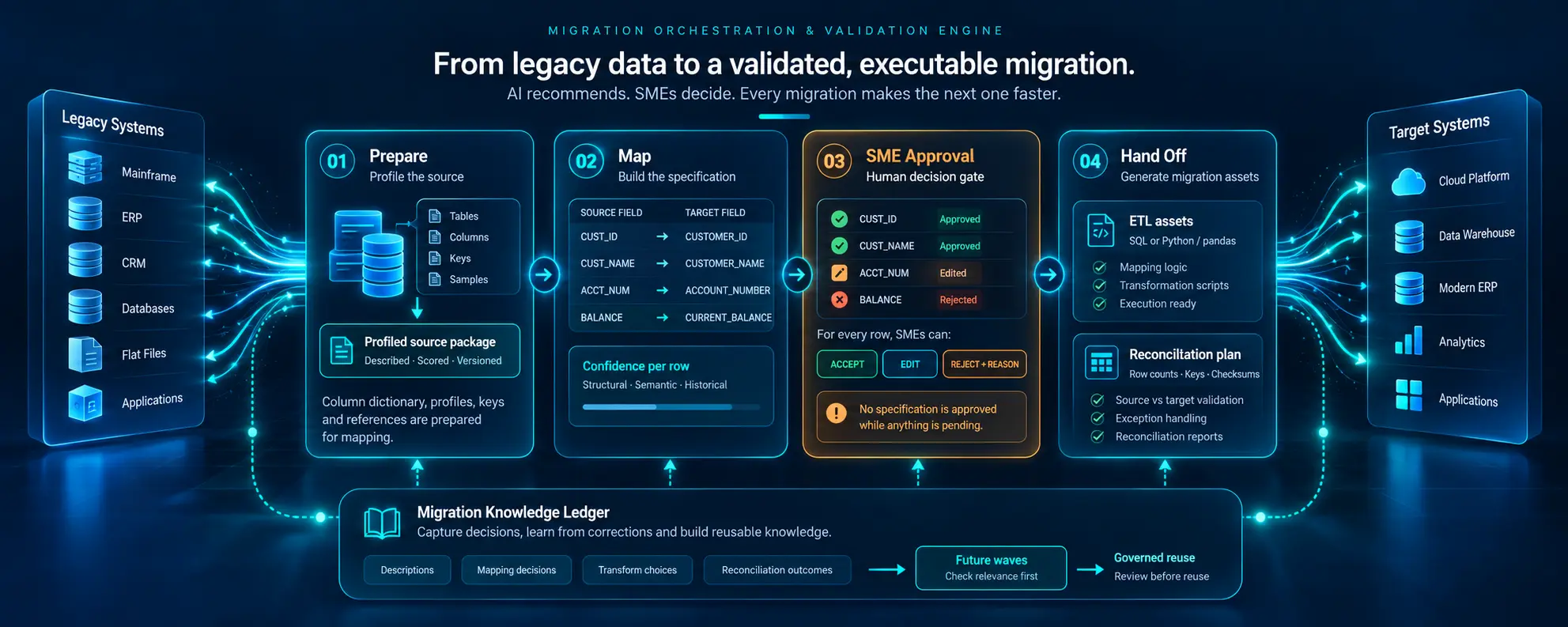
Approved descriptions and mapping decisions may be reused in later waves of the same programme when they remain relevant, are reviewed and are permitted by the configured workflow and programme rules. This page does not claim that migration knowledge is shared across clients.
Establish the source, target, scope and migration requirements.
Prepare and map source data, obtain SME approval, then generate migration assets.
Review eligible Wave 1 decisions and reuse only those that remain relevant.
Carry forward approved knowledge under agreed access and data-handling rules.