GRID.AI

Modernise with evidence. Not assumptions.

GRID.AI helps financial institutions across banking, cards and payments decide what to migrate, retire or rebuild, in what order and at what cost, from an evidence-backed map of their own legacy ecosystem.
Domain-led insight Banking Cards Payments
The challenge

You can’t modernise what you can’t see clearly.

Legacy documentation rarely tells the whole story. Critical dependencies and business rules can live in code, runtime behaviour, batch schedules and the experience of a few busy subject-matter experts.

⌘

Documentation gaps

Documents may describe the system as designed—not how it actually operates today.

⇄

Hidden dependencies

Interfaces, batch chains and shared data relationships can surface late in a programme.

◷

SME bottlenecks

Teams spend weeks explaining systems before they can validate a reliable baseline.

The decisions are only as good as the discovery behind them.
Introducing GRID.AI

Financial services context. Evidence teams can act on.

GRID.AI combines AI-powered discovery with deep technology and domain expertise to uncover system insights, identify gaps and dependencies, and help financial institutions move modernisation forward.

2 weeksTypical first baseline
8 weeksTypical full-ecosystem discovery
9Cited deliverables
TraceableFindings linked to source evidence
Why GRID.AI

Decisions you can defend, not just code analysed.

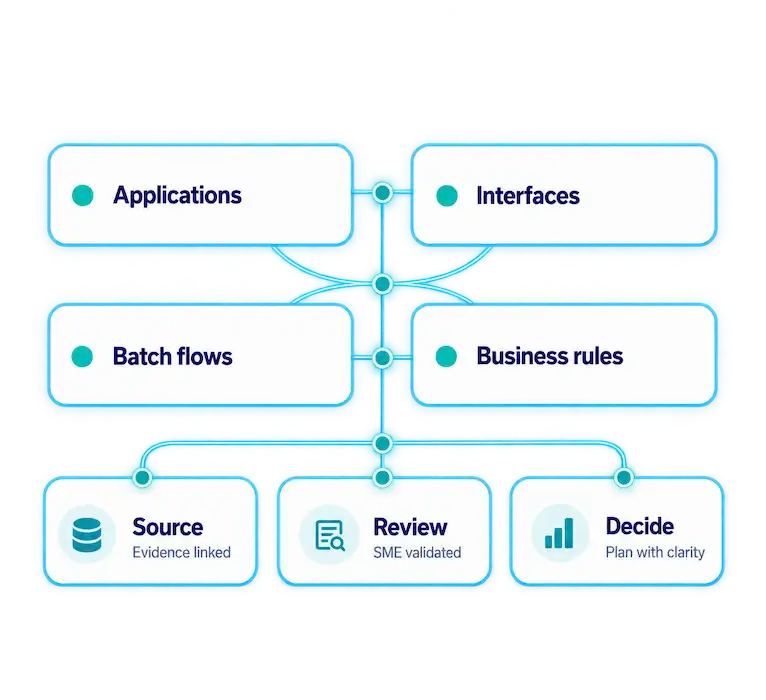
Built for banking, cards and payments, GRID.AI looks beyond source code. It connects applications, interfaces, batch flows, data and business rules, so every modernisation decision traces back to evidence.

⌕

Start from facts, not interviews

Code, schemas, schedules, logs and specifications are analysed first, so SME time goes on validating, not explaining.

◎

Findings in your domain’s language

Grounded in banking, cards, payments and reconciliation, so results reflect how your operations actually run.

↗

Defend every decision

Every fact links back to its source and conflicts are surfaced, so scope and sequencing choices stand up to scrutiny.

⇢

Move straight into build

Findings are organised for the next phase, so build and migration teams start from a baseline instead of rediscovering it.

◉

Experts stay in control

SMEs confirm, correct or reject findings, so disagreements are settled by people, not silently resolved.

▤

One version of the truth

Every deliverable comes from one connected evidence model, so teams aren’t working from conflicting documents.

From evidence to decisions

Connect technical facts to executive decisions.

The goal is not a longer inventory. It is a clearer decision about what to modernise, migrate, retire or investigate next—and in what sequence.

  • ✓Define migration scope and sequence the waves.
  • ✓Understand batch dependencies and critical cutover paths.
  • ✓Identify business rules to configure, retain or rebuild.
  • ✓Shape data migration and reconciliation approaches.
  • ✓Flag unused components, risks and gaps before delivery begins.
01

Know what you run

Build a structured view of applications, interfaces, jobs and data.

02

Know what connects

Map dependencies, business rules and end-to-end processes.

03

Know what matters

Surface gaps, conflicts and potential risks for expert review.

04

Know what comes next

Use the findings to inform scope, waves, budget and cutover planning.

For executive decision-makers

Give decision-makers a clearer basis for the next move.

Bring technical findings into the conversations that shape investment, delivery scope and migration planning.

↗

For business leaders: investment clarity

Build a more grounded view of scope, sequencing, delivery exposure and the decisions that need leadership alignment.

⌘

For technology leaders: technical visibility

Understand applications, interfaces, batch dependencies, data relationships and business rules before shaping the target-state plan.

◉

For transformation leaders: execution readiness

Identify gaps, dependencies and unresolved questions early, then use cited deliverables to support migration waves and cutover planning.

THE GRID.AI DISCOVERY WORKFLOW

From legacy complexity to decision-ready evidence.

See how GRID.AI connects system artefacts, dependencies and business rules to help financial institutions assess scope, sequencing and modernisation priorities.

GRID.AI · DISCOVERY AS A SERVICE
GRID.AI turns legacy complexity into a clear modernisation view A structured three-stage visual: legacy systems and tangled dependencies flow into GRID.AI discovery, then into aligned decision-ready outputs. 01 / LEGACY ARCHITECTURE Current-state system landscape 02 / GRID.AI Evidence-led discovery 03 / OUTCOMES Decision-ready visibility 01 / LEGACY ARCHITECTURE Current-state system landscape Core banking systems Cards and payments Batch jobs and schedules Databases and files Interfaces and APIs Business rules and workarounds Documents and SME knowledge DEPENDENCY MAP Unknown links Conflicting rules DISCOVERY PIPELINE Ingest · Analyse · Connect · Validate GRID.AI AI-assisted analysis with SME validation AnalyseCode and artefacts MapLinks and rules Validate with subject-matter expertsResolve gaps, conflicts and assumptions STRUCTURED OUTPUTS 1 Application and interface mapInventory, connections and dependencies 2 Batch chains and critical pathExecution and dependency flow 3 Business rules and data lineageBusiness logic and data relationships 4 Risk and gap registerOpen questions and validation priorities< 5 Modernisation decision packScope, waves and cutover inputs
Evidence-linkedFindings trace back to source artefacts
Human-validatedGaps and conflicts go to the right SMEs
Decision-readySupports scope, sequencing and risk planning
The delivery approach

From your artefacts to a decision-ready handoff in six stages.

Each stage ends with something you can review.

Collect

Agreed artefacts, in one place.

Extract

Facts pulled from code, schemas and schedules.

Link

Findings connected in one fact graph.

Synthesise

Structured insights ready for review.

Validate

SMEs resolve gaps and conflicts.

Publish

Cited outputs ready for decisions.

What you receive

Nine deliverables that answer the questions migration teams ask.

Each is generated from a shared fact graph, so findings stay consistent and traceable to source artefacts.

01
Application inventoryKnow exactly what is in scope.
02
Interface catalogueSee what is affected when a system moves.
03
Batch and critical pathPlan cutover around real job dependencies.
04
Data dictionary and lineageShape data migration and reconciliation.
05
Business rules catalogueDecide which rules to configure, retain or rebuild.
06
End-to-end process mapsLink system behaviour to business outcomes.
07
Current-state architectureStart target-state design from the real estate.
08
Risk and gap registerResolve unknowns before delivery begins.
09
Evidence indexTrace any finding back to its source.
Case study

Clarity before a legacy portal exit.

A global card issuer needed a fact-based baseline before deciding how to exit a 15-year-old IBM portal stack.

The challenge

Understand a layered legacy platform before choosing the migration path.

The environment included 12 portlet modules, more than 350,000 lines of code and 930 code and configuration files. Business-logic documentation was incomplete, and a schema change could affect all 12 modules.

Decision enabled: incremental modernisation, with a phased sequence and vulnerable libraries flagged for remediation before migration work.

4 weeksTo baseline, versus 14 weeks planned manually
−78%SME effort reported in the case study
100%Of reported facts traced to file, version and line
30Integration links identified
180+Business rules mapped
6Regulatory frameworks mapped to modules
Security and control

Your data, your environment, your controls.

Deployment and data handling can be aligned to your environment and requirements.

Masking before AI

Sensitive data is masked before anything is sent to an AI model.

Read-only access

GRID.AI reads agreed input locations and writes only to the agreed output.

Client-held keys

Per-client encryption, with options for keys you control.

Audit trail

Reads, AI calls and decisions are logged, so every step is traceable.

Deployment choice

Choose pull, hybrid, or deployment within your own AWS account.

Model flexibility

An LLM gateway supports provider choice, subject to your requirements.

Engagement options

Start with the scope that matters.

Begin with one platform or build a connected baseline across the agreed ecosystem. We’ll shape the scope around the decision you need to make.

Discovery Sprint

2–4 weeks · Fixed fee

Know enough about one platform to make your next decision.

  • A baseline of applications, interfaces and batch jobs
  • A risk and gap register showing what to resolve first
  • A decision pack for your next step

Continuous Discovery

Subscription · Annual fee

Keep decisions grounded as the estate changes during migration.

  • A baseline that re-runs as the ecosystem changes
  • A current view for each migration wave
  • Fresh evidence for ongoing build and migration

GRID.AI

Make your next modernisation decision with better evidence.

Tell us about your environment and priorities. We’ll show how GRID.AI can help establish a traceable view of your legacy estate and support more confident decisions on scope, sequencing and risk.

See GRID.AI in action
A focused walkthrough of legacy system intelligence and modernisation.
Request a Demo
Legacy analysis · Dependency mapping · AI-powered insights